Memory Engineering: The Discipline That Decides Whether Your AI Agent Has a Past
Every agent you've ever used has perfect intelligence and zero memory. It reasons brilliantly for exactly one session, then wakes up tomorrow as a stranger. Memory engineering is the discipline that fixes this - and almost nobody is doing it correctly yet.

The smartest model in the world, run twice, produces two unrelated conversations. Ask it Monday what you told it Friday and it has nothing - not a gap, not a guess, just silence where a relationship should be.
For two years the industry treated this as acceptable. Bigger context windows were the answer: just keep stuffing more of the past into every future prompt. That approach is now visibly buckling. A million-token window doesn't remember you - it just re-reads a transcript of you, slower and more expensively, every single time.
Memory engineering starts from a different premise: memory isn't a bigger window. It's a system with its own architecture, separate from context, separate from the model, built to decide - deliberately, not accidentally -what a system carries forward and what it lets go.
Why re-reading everything isn't memory
Feeding an agent its entire history at the start of every session looks like memory. It behaves like something else entirely.
It doesn't scale. A user with six months of history costs more in tokens on message one than a new user costs in an entire week.
It doesn't discriminate. A passing comment about liking coffee and a hard constraint about a client's compliance requirement get equal weight, because nothing separated them at the time.
It doesn't update. If a fact changes - a job title, a deadline, a decision reversed last week - a full transcript replay just contains both the old and new version, contradicting each other, with no signal for which one is current.
Human memory doesn't work by replaying your whole life before every decision. It works by encoding selectively, consolidating over time, retrieving contextually, and forgetting aggressively. Memory engineering borrows that shape, because it's the only shape that has ever worked at scale - biological or otherwise.
The five-stage pipeline
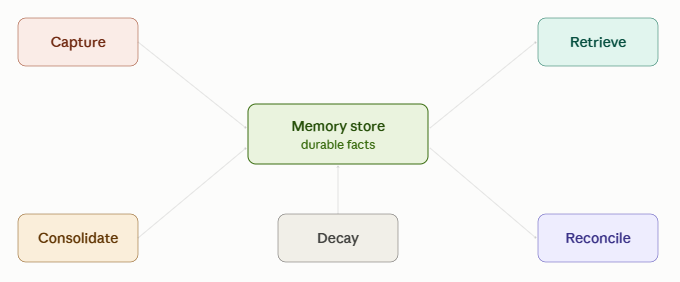
Five operations, each solving a different failure mode of naive "just save everything" memory systems.
Stage 1 - Capture
Not everything said deserves to be remembered. Capture is the filter that decides, at the moment something is said, whether it's durable or disposable.
The test that matters: would this still be true and useful in three months? "I'm frustrated with this bug" is disposable - it expires the moment the bug is fixed. "I prefer terse code reviews with no preamble" is durable - it should shape every future interaction.
python from dataclasses import dataclass from enum import Enum from datetime import datetime
class MemoryClass(Enum): EPHEMERAL = "ephemeral" # true only in this session DURABLE = "durable" # true for months, not tied to a date EXPIRING = "expiring" # true until a known event/date
@dataclass class CapturedFact: content: str memory_class: MemoryClass source_turn: int confidence: float captured_at: datetime
def classify_for_capture(statement: str, context: dict) -> CapturedFact | None: """ Decide whether a statement is worth writing to memory at all. Most statements in a conversation are NOT memory-worthy -- this is a filter, not a logger. """ signals = { "has_preference_language": any( phrase in statement.lower() for phrase in ["i prefer", "i always", "i never", "my rule is"] ), "has_stable_fact": any( phrase in statement.lower() for phrase in ["i work at", "i'm based in", "my role is"] ), "has_transient_marker": any( phrase in statement.lower() for phrase in ["right now", "today", "this bug", "currently frustrated"] ), }
if signals["has_transient_marker"] and not signals["has_stable_fact"]:
    return None  # doesn't survive capture -- session noise

memory_class = (
    MemoryClass.DURABLE if signals["has_preference_language"] or signals["has_stable_fact"]
    else MemoryClass.EPHEMERAL
)

if memory_class == MemoryClass.EPHEMERAL:
    return None  # ephemeral facts aren't captured at all

return CapturedFact(
    content=statement,
    memory_class=memory_class,
    source_turn=context.get("turn", 0),
    confidence=0.8,
    captured_at=datetime.now()
)
Capture is a rejection system first and a storage system second. Most of what gets said in any conversation should never reach long-term memory at all - and a system that captures indiscriminately is building the exact "replay everything" problem it was meant to solve.
Stage 2 - Consolidate
Raw captured facts accumulate duplicates, near-duplicates, and fragments that belong together but arrived in separate turns. Consolidation is the process of merging them into a coherent, non-redundant memory store - the same job sleep does for human memory, compressing a day of scattered impressions into a handful of durable ones.
python from difflib import SequenceMatcher
def consolidate_memories(new_fact: CapturedFact, existing: list[CapturedFact]) -> str: """ Before writing, check whether this fact duplicates, extends, or contradicts something already stored. Returns an action: "insert", "merge", "supersede", "skip" """ for old in existing: similarity = SequenceMatcher(None, new_fact.content, old.content).ratio()
    if similarity > 0.92:
        return "skip"  # near-identical, already captured

    if similarity > 0.6 and _shares_subject(new_fact.content, old.content):
        if _is_contradiction(new_fact.content, old.content):
            return "supersede"  # newer fact replaces older one
        return "merge"  # related facts, combine into one entry

return "insert"  # genuinely new information
def _shares_subject(a: str, b: str) -> bool: """Rough overlap check on the subject of two statements.""" a_words = set(a.lower().split()) b_words = set(b.lower().split()) return len(a_words & b_words) / max(len(a_words), 1) > 0.3
def _is_contradiction(a: str, b: str) -> bool: """ Flag statements that share a subject but assert incompatible values -- the trigger for reconciliation. """ negation_pairs = [("prefer", "no longer"), ("always", "stopped"), ("is", "was")] a_low, b_low = a.lower(), b.lower() return any(p1 in a_low and p2 in b_low for p1, p2 in negation_pairs)
Without consolidation, a memory store doesn't grow smarter with use - it just grows. Ten mentions of the same preference across ten sessions should collapse into one confident entry, not sit as ten redundant rows competing for retrieval space.
Stage 3 - Retrieve
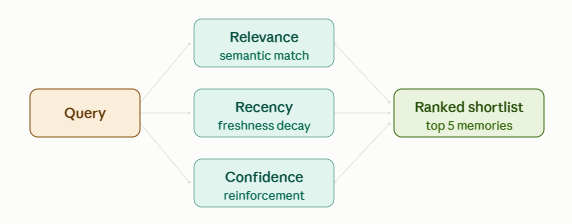
Storing memory well is only half the problem. The other half is deciding, for any given moment, which stored memories are actually relevant right now - not everything the system has ever learned about the user.
python import numpy as np from dataclasses import dataclass
@dataclass class StoredMemory: content: str embedding: np.ndarray memory_class: MemoryClass last_reinforced: datetime confidence: float access_count: int = 0
def retrieve_relevant( query: str, query_embedding: np.ndarray, memory_store: list[StoredMemory], top_k: int = 5 ) -> list[StoredMemory]: """ Retrieve memories scored on relevance to the current query, not just chronological or alphabetical recall. """ scored = [] now = datetime.now()
for memory in memory_store:
    semantic = _cosine_sim(query_embedding, memory.embedding)

    days_since_use = (now - memory.last_reinforced).days
    freshness = 1.0 / (1.0 + days_since_use / 60)

    # Memories reinforced by repeated relevance outrank one-off mentions
    reinforcement = min(memory.access_count / 10, 1.0)

    final_score = (
        0.6 * semantic +
        0.2 * freshness +
        0.1 * reinforcement +
        0.1 * memory.confidence
    )
    scored.append((memory, final_score))

scored.sort(key=lambda x: x[1], reverse=True)
top = [m for m, _ in scored[:top_k]]

for memory in top:
    memory.access_count += 1
    memory.last_reinforced = now

return top
def _cosine_sim(a: np.ndarray, b: np.ndarray) -> float: return float(np.dot(a, b) / (np.linalg.norm(a) * np.linalg.norm(b)))
The instinct to retrieve "everything that might be relevant" produces the same failure as never forgetting anything: dilution. A retrieval system that returns twenty marginally-related memories buries the two that actually mattered under noise the model has to wade through before it can use them.
Stage 4 - Reconcile

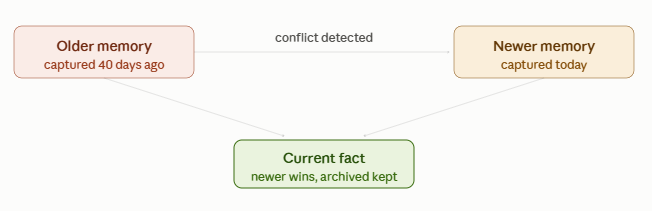
Facts change. A person switches jobs, changes a preference, reverses a decision. A memory system without reconciliation just accumulates contradictions and lets the model guess which one is true - usually by picking whichever one happens to load first.
python @dataclass class ReconciliationResult: action: str # "supersede", "coexist", "flag_conflict" current_fact: str archived_fact: str | None
def reconcile(new_fact: CapturedFact, conflicting: CapturedFact) -> ReconciliationResult: """ When two memories about the same subject disagree, decide which one is authoritative going forward. """ # Explicit temporal supersession -- the newer fact wins outright if new_fact.captured_at > conflicting.captured_at: time_gap_days = (new_fact.captured_at - conflicting.captured_at).days
    if time_gap_days > 1 and new_fact.confidence >= conflicting.confidence:
        return ReconciliationResult(
            action="supersede",
            current_fact=new_fact.content,
            archived_fact=conflicting.content
        )

# Facts that can genuinely coexist (e.g. multiple valid preferences
# for different contexts) shouldn't be forced into conflict
if _different_contexts(new_fact.content, conflicting.content):
    return ReconciliationResult(
        action="coexist",
        current_fact=new_fact.content,
        archived_fact=None
    )

# Ambiguous -- don't silently guess, surface it
return ReconciliationResult(
    action="flag_conflict",
    current_fact=new_fact.content,
    archived_fact=conflicting.content
)
def _different_contexts(a: str, b: str) -> bool: """Two preferences can both be true if they apply to different situations.""" context_markers = ["at work", "for personal", "on weekends", "in meetings"] a_context = next((m for m in context_markers if m in a.lower()), None) b_context = next((m for m in context_markers if m in b.lower()), None) return a_context is not None and b_context is not None and a_context != b_context
The "flag_conflict" branch matters more than it looks. A system that silently picks a side when it's genuinely unsure is a system that will confidently act on the wrong fact eventually. Surfacing ambiguity is slower than guessing - it's also the difference between a memory system you can trust and one you have to double-check.
Stage 5 - Decay
Every memory system that never forgets anything eventually becomes indistinguishable from one that remembers nothing well. Decay is the deliberate process of letting unused, unreinforced, or expired memories fade - not deleted violently, but weighted down until they stop competing for retrieval space.
python def apply_decay(memory_store: list[StoredMemory], decay_rate: float = 0.02) -> list[StoredMemory]: """ Run periodically. Reduces confidence on memories that haven't been reinforced recently. Memories that decay below a threshold get archived, not deleted outright. """ now = datetime.now() survivors = []
for memory in memory_store:
    days_idle = (now - memory.last_reinforced).days

    # Frequently-accessed memories resist decay
    resistance = min(memory.access_count * 0.05, 0.8)
    effective_decay = decay_rate * (1 - resistance) * (days_idle / 30)

    memory.confidence = max(0.0, memory.confidence - effective_decay)

    if memory.confidence > 0.15:
        survivors.append(memory)
    # else: archived to cold storage, not deleted --
    # recoverable if it becomes relevant again

return survivors
Decay is the stage most systems skip entirely, and it's the one that determines whether a memory store is still useful after a year of use or has become an unsearchable landfill of stale context competing on equal footing with what actually matters today.
The pipeline, assembled
python class MemoryEngine: """ The five stages working together as one system. This is the actual discipline -- no single stage does much alone. """
def __init__(self):
    self.store: list[StoredMemory] = []

def process_turn(self, statement: str, context: dict):
    # 1. CAPTURE -- filter for durability
    fact = classify_for_capture(statement, context)
    if fact is None:
        return  # not memory-worthy, discarded

    # 2. CONSOLIDATE -- check against existing memory
    action = consolidate_memories(fact, self._as_captured())

    if action == "skip":
        return
    elif action == "supersede":
        conflicting = self._find_conflict(fact)
        result = self.reconcile_and_apply(fact, conflicting)
    elif action in ("insert", "merge"):
        self._write(fact)

def retrieve_for_query(self, query: str, query_embedding) -> list[StoredMemory]:
    # 3. RETRIEVE -- relevance-scored, not chronological
    return retrieve_relevant(query, query_embedding, self.store)

def reconcile_and_apply(self, new_fact, conflicting):
    # 4. RECONCILE -- resolve contradictions deliberately
    result = reconcile(new_fact, conflicting)
    if result.action == "supersede":
        self._archive(conflicting)
        self._write(new_fact)
    return result

def run_maintenance(self):
    # 5. DECAY -- runs on a schedule, not per-turn
    self.store = apply_decay(self.store)

def _write(self, fact): ...
def _archive(self, fact): ...
def _find_conflict(self, fact): ...
def _as_captured(self) -> list: ...
Capture decides what's worth remembering at all. Consolidate keeps the store from bloating with duplicates. Retrieve ensures only what's relevant to right now actually surfaces. Reconcile keeps contradictions from silently coexisting. Decay keeps the whole system from calcifying into an unusable archive. Remove any one stage and the others compensate badly - a memory system with retrieval but no decay just gets slower every month; one with capture but no reconciliation just accumulates lies about itself.
What this changes
The agents that feel like they know you aren't running bigger models. They're running better memory pipelines - ones that decided, deliberately, what to keep, what to merge, what to surface, what to update, and what to let go.
Prompt engineering shaped what the model says. Context engineering shaped what the model sees in a single request. Memory engineering shapes what the model carries from every conversation into every future one - the actual difference between a tool that resets and a system that accumulates a relationship over time.
That's not a bigger context window. It's an architecture. And right now, almost nobody has built one properly.
This article describes memory system design patterns as of July 2026. Code examples are illustrative - production systems require persistent storage, embedding infrastructure, and careful tuning of decay rates and consolidation thresholds for your specific domain.
Thank you for reading.